
Occupational Therapy for Handwriting: How OT Helps Children Improve Writing Skills
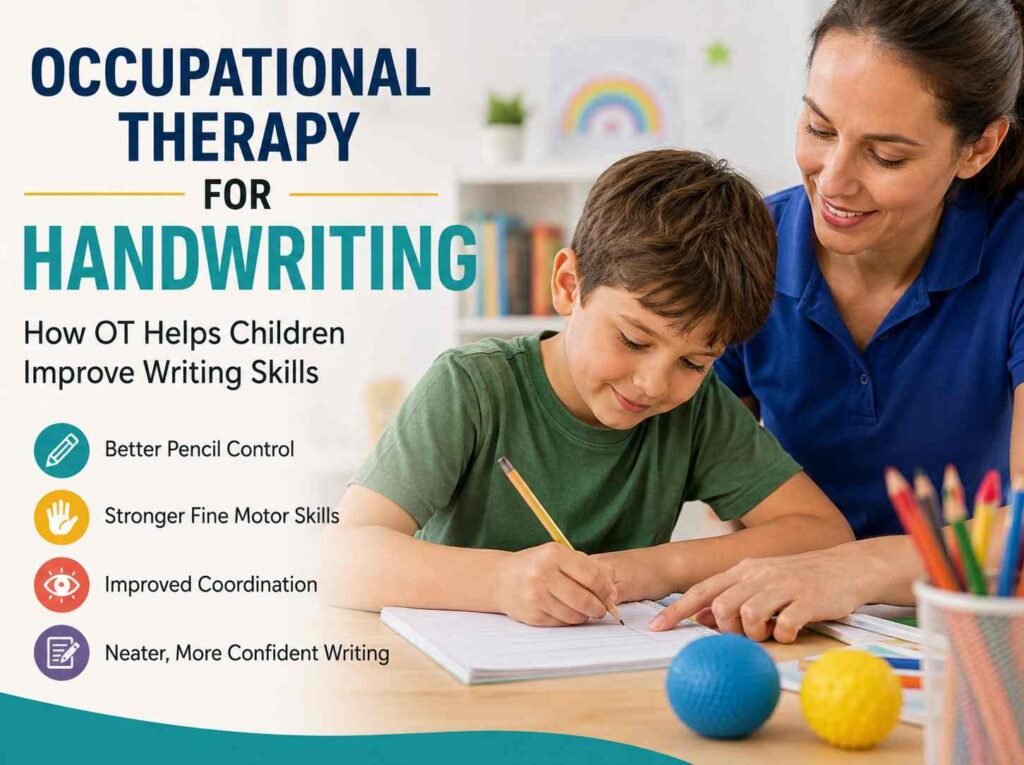
Occupational therapy for handwriting can help children develop the skills they need to write more comfortably, efficiently and independently. A paediatric occupational therapist can assess factors such as fine motor control, pencil grasp, hand strength, posture, visual-motor integration, coordination and handwriting mechanics, then provide strategies based on the child’s individual needs. Handwriting difficulties can look different from one child to another. Some children struggle with letter formation or spacing, while others write very slowly, tire quickly, press too hard with their pencil or avoid writing altogether. Understanding the reason behind the difficulty is an important first step towards effective support. What Is Occupational Therapy for Handwriting? Occupational therapy for handwriting is an individualised approach that addresses the physical, visual, motor and functional skills involved in writing. Instead of focusing only on repeated handwriting practice, an occupational therapist looks at the complete writing process. This can include: Handwriting is an important school-based activity, so difficulties with writing can affect more than the appearance of a child’s work. They can also influence classroom participation, confidence, task completion and independence. How Does Occupational Therapy Help With Handwriting? Occupational therapy can improve handwriting by identifying the underlying skills that are making writing difficult and targeting those skills through purposeful activities. For example, a child who struggles to control a pencil may need support with fine motor control and hand strength. A child whose writing is poorly aligned may have difficulty with visual-motor integration or spatial awareness. Another child may know how letters should look but struggle to form them because the required hand movements are difficult. An occupational therapist can therefore look beyond messy handwriting and determine which areas may be affecting functional writing. What Handwriting Problems Can Occupational Therapy Address? Children may benefit from occupational therapy when handwriting difficulties are persistent or interfere with everyday school activities. Common signs include: A child does not need to have a diagnosed condition to experience handwriting difficulties. An occupational therapy assessment can help identify the skills that may need additional support. What Does an Occupational Therapist Assess for Handwriting? A handwriting occupational therapy assessment can involve much more than looking at a sample of written work. The therapist may observe how the child sits, holds the pencil, moves their fingers and hands, processes visual information and manages a writing task. Pencil Grasp and Pencil Control The way a child holds and moves a pencil can affect writing efficiency and comfort. An occupational therapist may assess pencil grasp, finger movement, pencil pressure and overall pencil control. Where appropriate, the therapist may trial different pencil grips or writing tools to determine whether they make writing easier. Fine Motor Skills Fine motor skills involve the controlled movement of the hands and fingers. Children use these skills for pencil manipulation, drawing, cutting, fastening clothing and many other everyday activities. Developing fine motor control can therefore support the movements required for handwriting. Hand Strength and Endurance Handwriting requires sustained, controlled movements. Reduced hand strength or endurance may contribute to tiredness during writing. An occupational therapist may use activities that develop finger strength, hand strength and endurance when these skills are relevant to the child’s handwriting difficulties. Visual-Motor Integration Visual-motor integration involves coordinating visual information with hand movements. It can influence letter formation, sizing, alignment, spacing and copying. A child may understand what a letter should look like but still find it difficult to reproduce the shape accurately on paper. Posture and Positioning A stable sitting position can help support controlled hand movements. An occupational therapist may look at the child’s posture, seating position, desk height, wrist position and overall positioning during handwriting. Motor Planning and Attention Handwriting requires children to remember movement patterns, organise their actions and remain engaged with the task. Difficulties with motor planning or attention may affect writing performance. What Are Some Occupational Therapy Activities for Handwriting? Occupational therapy handwriting activities should be selected according to the child’s individual needs. The purpose is to develop skills that can transfer into functional writing rather than simply keeping the child busy. Activities may include: Tactile handwriting activities can also provide children with another way to learn and practise letter shapes before transferring those movements to paper. The most appropriate activities depend on the child’s assessment. A child with reduced hand strength may need a different intervention from a child whose primary difficulty is visual-motor integration. Can Occupational Therapy Improve Pencil Grip? Yes, occupational therapy can address pencil grip when the child’s grasp is affecting handwriting function. However, there is not necessarily one perfect pencil grasp that every child must use. An occupational therapist considers whether the child’s grasp allows adequate control, comfort, efficiency and endurance. If pencil control is difficult, an OT may explore pencil grips, different pencil sizes, positioning or preparatory fine motor activities. These strategies should be chosen based on the child’s individual needs rather than simply changing a grasp because it looks different. How Can I Improve My Child’s Handwriting at Home? Parents can support handwriting development with short, practical activities that build the skills needed for writing. Useful activities may include: Keep practice manageable and focus on quality rather than making a child complete long handwriting sessions. If handwriting consistently causes fatigue, frustration or avoidance, simply increasing handwriting practice may not address the underlying difficulty. An occupational therapy assessment can help identify what is making the task challenging. For additional support, see Paediatric Occupational Therapy. When Should a Child See an Occupational Therapist for Handwriting? Consider an occupational therapy assessment when handwriting difficulties are persistent, interfere with school participation or cause significant frustration or fatigue. Professional support may be worth considering if your child: An assessment does not automatically mean that a child has a developmental or learning condition. It can simply help identify their strengths, difficulties and appropriate support strategies. Can OT Help With Dysgraphia? OT can support the functional handwriting difficulties associated with dysgraphia, but poor handwriting alone does not establish a dysgraphia diagnosis. Dysgraphia can involve difficulties with written expression and handwriting.