
How Occupational Therapy Builds Real Independence: A Complete Guide for Australian Families
Suppose you’ve ever wondered how much difference the right support can make in someone’s life. In that case, you’ll understand why occupational therapy for daily living skills in Australia is becoming one of the most searched topics today. Whether it’s helping a child brush their teeth independently, guiding an NDIS participant to manage their morning routine, or supporting an adult to return to meaningful daily activities, the impact is real, visible, and life-changing.
And the most inspiring part? Occupational therapy isn’t just about therapy sessions — it’s about empowering people to take charge of their lives, one small skill at a time.
Understanding Occupational Therapy Through Real Australian Experiences
Let’s start simple.
Occupational therapy, or OT, focuses on helping people of all ages perform the tasks they want and need to do — their occupations.
For a child, that might mean handwriting, dressing, or feeding.
For an adult, it may be cooking, working, or managing personal care.
The goal is always the same: greater independence.
In Australia, OT plays a major role within NDIS, disability support, aged care, mental health, and paediatric development. Families rely heavily on occupational therapists because they provide both emotional support and practical solutions that actually work.
Whether someone has developmental delays, autism, sensory processing challenges, physical disabilities, or age-related concerns, occupational therapy helps them function better in real life.
Why Occupational Therapy for Daily Living Skills in Australia Matters Today
This is your keyword as an H2 heading (used once exactly as requested).
When we talk about occupational therapy for daily living skills in Australia, what we’re really talking about is giving people the confidence to tackle everyday life — without feeling dependent or overwhelmed.
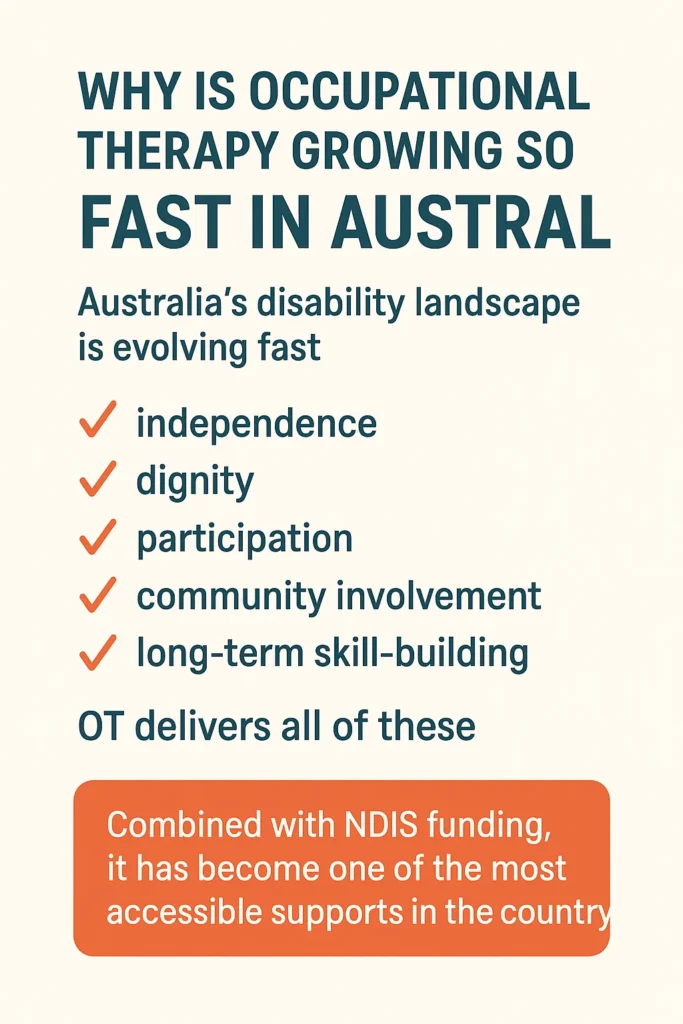
Australians are looking for ways to help their children, loved ones, or themselves gain more stability, more skills, and more freedom. With an ageing population and a rapidly growing number of NDIS participants, OT is more important today than ever before.
According to Australian disability data, over 530,000 participants are currently supported by NDIS, and occupational therapy ranks among the top requested supports. Families want practical help, not just medical explanations. They want solutions that fit into their everyday routines.
And that’s exactly what occupational therapists specialise in.
How Occupational Therapy Builds Daily Independence — Real-Life Examples
1. A Child Learning to Tie Shoelaces
Imagine a child in Melbourne struggling every morning with shoelaces. Something so small leaves them frustrated daily. An occupational therapist steps in, not with impossible expectations but with breakdown steps and adapted methods.
Within weeks, the child becomes confident enough to tie their laces independently.
It seems small — but to that child, it’s a miracle.
2. An Adult Regaining Confidence After an Injury
A Brisbane man recovering from a wrist injury struggled with basic kitchen tasks — holding cups, cutting fruit, and opening jars.
His occupational therapist introduced strengthening exercises, adaptive utensils, and energy-conservation techniques.
Within months, he was back to preparing meals, living more independently, and reducing his reliance on family support.
3. Supporting NDIS Participants With Routines
A young woman with ASD in Sydney struggled with her morning routine — brushing hair, choosing clothes, and organising her backpack.
An OT used visual schedules, sensory regulation strategies, and repetition.
The result? Her mornings transformed from chaos to calm.
These are not exaggerated stories — they are everyday experiences in the world of OT.
Skills Occupational Therapy Helps Improve
Occupational therapists help with nearly every part of daily life, including:
Fine Motor Skills
Writing
Buttoning
Cutting with scissors
Opening containers
Gross Motor Skills
Balance
Coordination
Movement planning
Strength-building
Self-Care Skills
Bathing
Dressing
Feeding
Toileting
Grooming
Household and Community Skills
Cooking
Cleaning
Shopping
Using public transport
Managing time
Cognitive and Behavioural Skills
Following instructions
Emotional regulation
Memory
Organisation
Every improvement — no matter how small — builds confidence and independence.
How Occupational Therapy for Daily Living Skills in Australia Works (Process Explained)
Here comes your keyword used again naturally.
Most people don’t realise that occupational therapy is not a one-size-fits-all service. Every journey starts with understanding who the person is and what they need.
Step 1: Assessment
The occupational therapist observes daily challenges and identifies strengths.
This could include:
- sensory assessments
- motor skill assessments
- home environment evaluation
- functional behaviour assessments
- Daily habits and routines review
Step 2: Building a Personalised Plan
The therapist sets achievable, realistic goals.
For example:
- brush hair independently
- Write a sentence without assistance
- Manage morning routine within 20 minutes
- Cut vegetables safely
Step 3: Therapy Sessions
Therapy is play-based for kids, practical for adults, and supportive for seniors.
Sessions may happen:
- at home
- at school
- in clinic
- in the community
- online (telehealth)
Step 4: Family and Caregiver Training
Occupational therapists understand that independence requires consistency.
So they teach parents, carers, teachers, and support workers exactly how to support the person between sessions.
Step 5: Reviewing Progress
The plan evolves as skills grow.
This approach is why occupational therapy for daily living skills in Australia is so effective: it meets people where they are and helps them move forward at their own pace.
How OT Supports Children Specifically
Parents often feel overwhelmed when their child struggles with dressing, handwriting, focus, or emotional control. Occupational therapists step in with a gentle, playful, structured support system.
Children improve because therapy feels like fun, not pressure.
They learn new skills naturally — through games, sensory activities, motor exercises, and gradual practice.
If you are looking for the Best Paediatric Occupational Therapist in Australia, you can explore expert-led services at Iconic Care Group here: Best Paediatric Occupational Therapist Australia
This ensures your child receives high-quality, child-friendly, development-focused therapy.
How OT Supports Adults and Seniors
Adults benefit from OT when recovering from:
- stroke
- injury
- surgery
- chronic pain
- arthritis
- cognitive decline
- disability-related difficulties
Seniors rely on OT to stay independent in their homes longer — reducing falls, adapting living spaces, and improving mobility.
How Parents and Carers Can Support OT at Home
Here are a few small but powerful things families can do:
- Encourage independence, even if tasks take longer
- Create predictable routines
- Reduce distractions during daily tasks
- Celebrate small achievements
- Use visual charts or reminders
- Keep the environment child- and disability-friendly
- Follow the recommendations from the therapist consistently
When home and therapy work together, progress accelerates.
Conclusion
Occupational therapy for daily living skills in Australia is more than a therapy — it’s a pathway to independence, confidence, and meaningful participation in life. Whether it’s a child learning self-care or an adult regaining function, OT empowers people to live fully, proudly, and independently.
Frequently Asked Questions
1. Is occupational therapy covered by NDIS?
Yes, OT is one of the most commonly funded supports under NDIS for both children and adults.
2. How long does occupational therapy take to show results?
Most people start seeing improvements within a few weeks, depending on consistency and goals.
3. Can OT help children with autism?
Absolutely. OT is one of the most effective therapies for sensory issues, emotional regulation, and daily living skills in children with ASD.
4. Do adults benefit from OT services too?
Yes. Adults recovering from injuries, surgeries, chronic illnesses, or disabilities benefit greatly from OT.