
Most parents don’t book a paediatric therapy assessment because they want a diagnosis.
They do it because they’re worried, confused, or simply unsure if what they’re seeing is “normal”.
Maybe your child isn’t talking as much as others.
Maybe mornings are a struggle.
Maybe school has raised concerns.
If you’re asking yourself what happens during a paediatric therapy assessment, you’re not alone. Almost every parent feels nervous before the first appointment — and that’s completely natural.
This article explains the process in plain, honest language, without medical jargon or pressure.
What Happens During a Paediatric Therapy Assessment
Understanding what happens during a paediatric therapy assessment helps remove fear from the process. It is not an exam. Your child is not being judged, tested, or compared.
A paediatric therapy assessment is simply a structured way to understand how your child functions in everyday life — emotionally, physically, socially, and developmentally.
The focus is always on support, not labels.
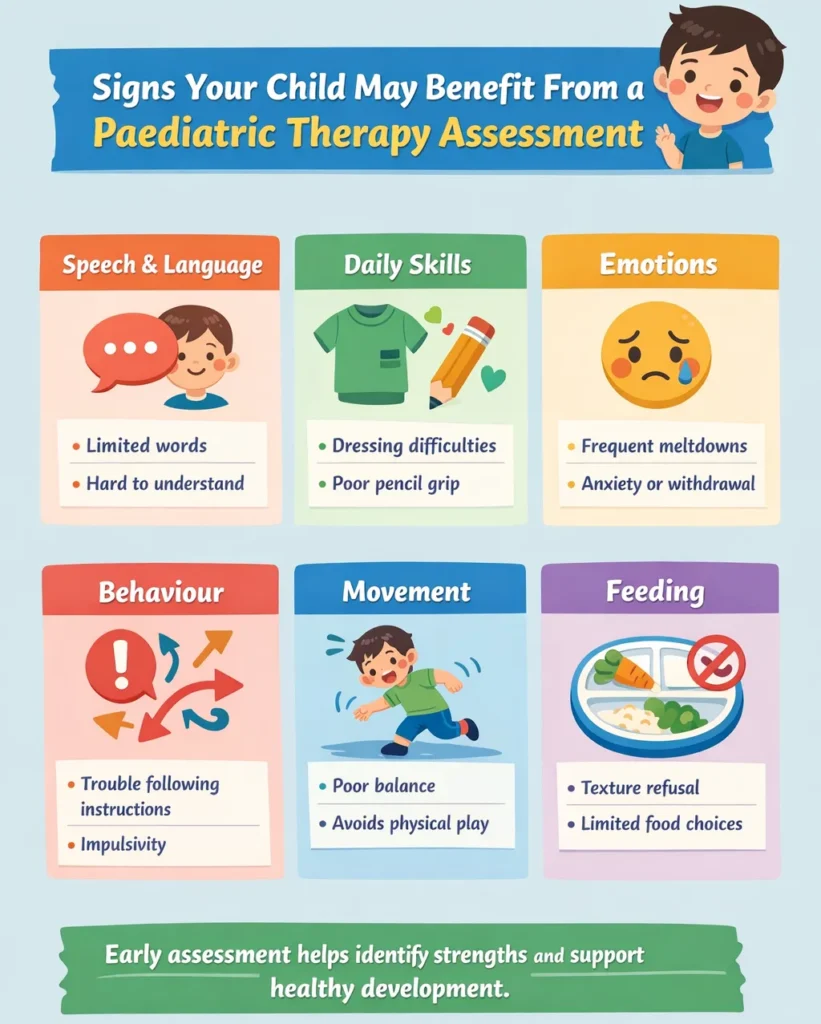
Why Parents Usually Seek an Assessment
Most families don’t wake up one day and suddenly book an assessment.
It usually follows weeks or months of small concerns, such as:
- “Something feels off, but I can’t explain it”
- “My child is trying hard but still struggling”
- “School has mentioned delays or behaviour”
- “Other kids seem to be coping better”
An assessment gives parents clarity instead of constant guessing.
Before the Appointment: What You’ll Be Asked
Before you arrive, you’ll usually be asked to share information about your child. This might include:
- Pregnancy and birth history
- Developmental milestones
- Medical background
- School or childcare feedback
- Your main concerns as a parent
There are no right or wrong answers here.
This information helps the therapist understand your child’s world — not just what they see in one session.
First Moments Matter: Creating Comfort
When families arrive, the first goal is simple: help your child feel safe.
There is no rushing, no pressure to “perform”, and no expectation that your child behaves a certain way. Therapists know children need time to warm up.
Often, the session starts with free play while the therapist quietly observes.
This is a key part of what happens during a paediatric therapy assessment, because children show their true abilities when they feel relaxed.
Learning Through Play (Not Testing)
Play is how children communicate.
Through play, therapists look at:
- How your child explores toys
- How do they solve problems
- How they interact with others
- How they respond when something is challenging
Nothing feels forced.
There are no scores, timers, or pressure.
Looking at Speech and Communication
If communication is a concern, the therapist may gently explore:
- How your child understands language
- How they express needs and ideas
- Clarity of speech sounds
- Social communication skills
This part is often very subtle — many children don’t even realise they’re being assessed.
Observing Daily Living and Motor Skills
Some children struggle with everyday tasks that others manage easily.
During the session, therapists may notice:
- How your child holds objects
- How they use their hands
- How they respond to sensory input
- How do they manage simple tasks
These observations help identify areas where occupational therapy may help.
Paediatric Occupational Therapy
Understanding Behaviour and Emotional Responses
Behaviour is communication.
If a child becomes overwhelmed, avoids tasks, or reacts strongly to change, therapists look at why, not just what is happening.
They consider:
- Emotional regulation
- Attention and focus
- Coping strategies
- Response to structure and routine
Emotional Wellbeing and Mental Health
Some concerns aren’t obvious on the surface.
Quiet anxiety, low confidence, or emotional withdrawal are often explored through gentle conversation, play, and parent feedback.
Physical Development and Movement
If movement is a concern, therapists may observe:
- Balance and coordination
- Strength and posture
- Endurance during play
This is never about athletic ability — it’s about functional movement in daily life.
Parents Are Actively Involved
One important thing parents often don’t expect is how involved they are.
You may be asked:
- What do you notice at home
- What situations are hardest
- What goals matter most to your family
Your insight is just as important as the therapist’s observations.
Does the Assessment Upset Children?
In most cases, no.
Therapists follow the child’s lead. If a child is tired, shy, or feeling overwhelmed, the session is adapted accordingly. Breaks are normal. Flexibility is expected.
A child’s comfort always comes first.
After the Assessment: What You’ll Learn
After the session, the therapist will:
- Explain what they observed
- Highlight strengths as well as challenges
- Discuss whether therapy is recommended
You won’t be left wondering what it all means.
This stage is often where parents finally feel relief, because things start to make sense.
Do All Assessments Lead to Therapy?
Not necessarily.
Some children only need:
- Monitoring
- Home strategies
- School adjustments
Others benefit from ongoing therapy support.
The assessment helps choose the right path, not the most intensive one.
How This Fits Into Paediatric Therapy Services in Australia
Assessments are the foundation of ethical, effective Paediatric Therapy Services in Australia. Without them, therapy becomes guesswork.
With them, support becomes personalised, targeted, and meaningful.
Preparing Your Child (Without Stress)
You don’t need to overprepare.
Simple explanations work best:
- “You’re going to play and meet someone new”
- “I’ll be there with you”
- “There’s no right or wrong”
Children take emotional cues from parents, so calm reassurance goes a long way.
Conclusion
Knowing what happens during a paediatric therapy assessment helps parents replace anxiety with understanding. These assessments are gentle, flexible, and centred on supporting a child’s unique strengths — not labelling or judging them. With the right guidance and professional support, families can move forward feeling informed, reassured, and confident in their child’s developmental journey.
Frequently Asked Questions
1. How long does a paediatric therapy assessment usually take?
Most paediatric therapy assessments take between 60 to 90 minutes, depending on your child’s needs and the areas being explored. Some children may need more than one session, especially if multiple developmental areas are involved.
2. Do parents stay with their child during the assessment?
Yes. Parents are usually encouraged to stay involved throughout the assessment. Your observations, answers, and comforting presence help therapists gain a clearer picture of how your child behaves in everyday situations.
3. Is a paediatric therapy assessment stressful for children?
In most cases, no. Assessments are play-based and flexible, designed to follow the child’s pace. Therapists adjust activities if a child feels tired, shy, or overwhelmed, ensuring the experience remains supportive rather than stressful.
4. Does an assessment always mean my child will need therapy?
Not always. Some assessments result in simple home strategies, monitoring, or school support rather than ongoing therapy. The purpose is to understand your child’s needs, not to automatically recommend treatment.
5. How do I know if my child needs an assessment in the first place?
If you notice ongoing challenges with communication, behaviour, emotional regulation, movement, learning, or daily skills — or if educators have raised concerns — an assessment can provide clarity and peace of mind.