
Welcome to your comprehensive guide on Home Care Packages in Australia. If you or a loved one are exploring options to receive subsidised care while remaining in the comfort of your own home, you’re in the right place.
Home Care Packages are government-funded programs designed to provide older Australians with tailored support services—everything from personal care and domestic assistance to nursing and allied health services.
In this guide, we’ll walk through everything you need to know: from eligibility and application processes, to costs, providers, and tips for maximising your package benefits. By the end, you’ll have a clear roadmap for navigating the Home Care Packages landscape in Australia.
Last reviewed: 29 October 2026.
What Are Home Care Packages?
Home Care Packages are part of Australia’s Aged Care system, subsidising a range of services to support older people who wish to remain at home. Through a consumer‑directed care model, you choose a service provider and decide which services best meet your needs—whether that’s assistance with showering, meals, cleaning, or allied health services like physiotherapy.
Key features include:
- Government subsidy covering the bulk of your care costs.
- Consumer choice, allowing flexibility in service providers and type of support.
- Tailored care plans, developed in consultation with you and your provider.
Understanding the Home Care Packages Program
Australia’s Home Care Packages Program offered four levels of care, from basic (Level 1) to high needs (Level 4). For the latest official figures, including current recipient and waitlist numbers, see the Department of Health, Disability and Ageing website (health.gov.au).
Despite significant rollout, wait times remain a challenge—recent reports indicate delays of up to 15 months for some high‑level packages.
Who Is Eligible for Home Care Packages?
To qualify, you must:
- Be assessed by an Aged Care Assessment Team (ACAT) or Aged Care Assessment Service (ACAS in Victoria).
- Demonstrate care needs that warrant a package at one of the four levels.
- Be an Australian citizen, permanent resident, or hold an eligible visa.
Your assessor evaluates physical, medical, and social needs to recommend the appropriate package level.
Levels of Home Care Packages
| Level | Description | Approx. Annual Government Funding (2024) |
| 1 | Basic care needs (e.g., light assistance) | ~$10,700 |
| 2 | Low care needs (e.g., personal care, transport) | ~$18,800 |
| 3 | Intermediate care needs (e.g., clinical nursing) | ~$40,900 |
| 4 | High care needs (e.g., complex support) | ~$61,400 |
Each level increases the hours and types of services you can access. Supplements, like the Dementia Supplement or Veterans Supplement, can add extra funds as needed.
Costs and Fees
While the government covers most costs, you may incur:
- Basic daily fee: A small contribution based on your age pension (up to 17.5% of single pension).
- Income‑tested care fee: Means‑tested fee if your income exceeds Centrelink thresholds.
- Package management fee: Charged by providers for administration (capped at 15% of package funds).
- Care management fee: For coordinating your services (up to 10% of package funds).
The Department of Health publishes quarterly median prices for common services and management fees to improve transparency (Health.gov.au). Always review your provider’s fee schedule and compare across providers.
Choosing the Right Provider for Your Home Care Packages
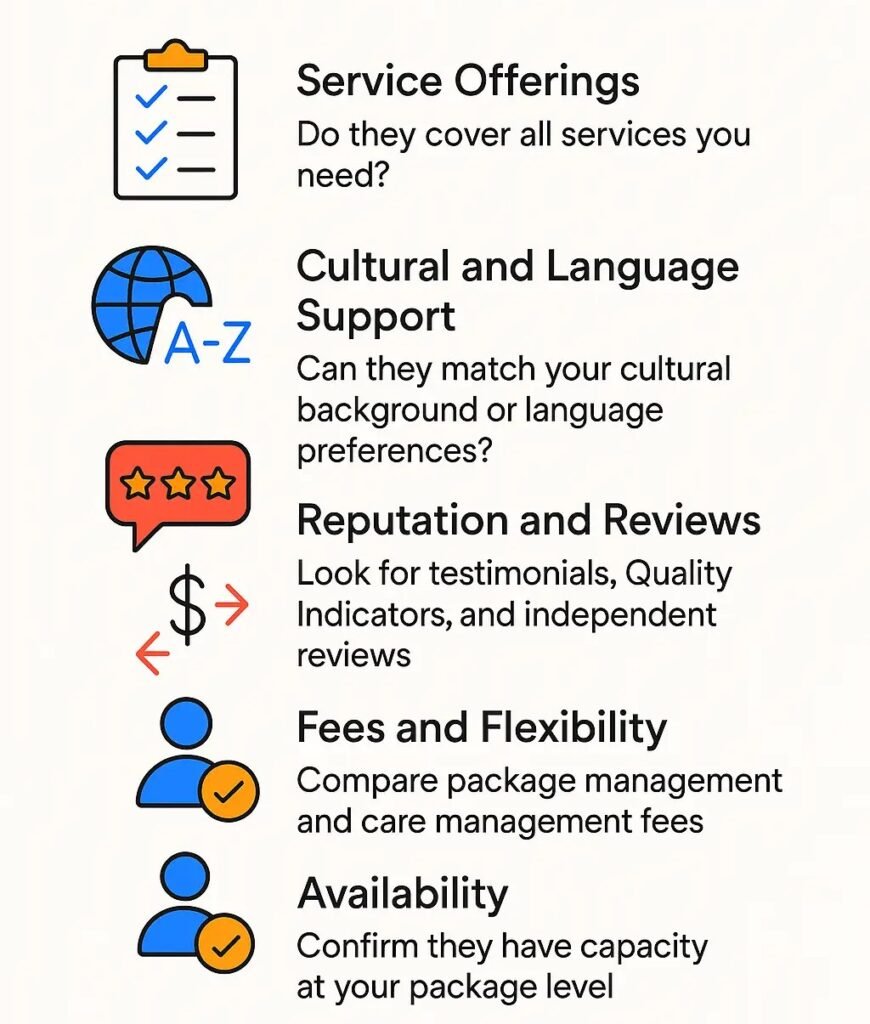
Selecting a provider is one of the most important decisions you’ll make. Consider:
- Service offerings: Do they cover all services you need?
- Cultural and language support: Can they match your cultural background or language preferences?
- Reputation and reviews: Look for testimonials, Quality Indicators, and independent reviews.
- Fees and flexibility: Compare package management and care management fees.
- Availability: Confirm they have capacity at your package level.
Use the My Aged Care “Find a Provider” tool and third‑party comparison sites to shortlist providers.
Managing Your Home Care Packages
Once your package starts, effective management ensures you get the most value:
- Care plan reviews: Schedule regular reviews (at least annually) to adjust services as needs change.
- Budget tracking: Monitor your spend through provider statements or the My Aged Care portal.
- Self‑management option: Some providers allow you to self‑manage funds, giving you direct control over invoices and service agreements.
- Support coordination: Engage case managers or support coordinators for tailored assistance and advocacy.
Effective management of Home Care Packages promotes independence and reduces unused funds slipping away.
Tips for Maximising Your Home Care Packages
- Plan ahead: Identify upcoming needs—like outings or specialist appointments—to avoid last‑minute rushes.
- Use supplements: If eligible, add Dementia or Veterans Supplements to boost your budget.
- Combine services: Bundle domestic assistance with transportation to optimise hours.
- Engage allied health: Physiotherapy or occupational therapy can prevent hospitalisations and save on future care costs.
- Review providers annually: Flexibility to switch if your current one isn’t meeting expectations.
- Document everything: Keep a folder of agreements, invoices, and statements for clarity and disputes.
By proactively planning and reviewing, you’ll maximise your Home Care Packages benefit.
The Support at Home Program
The Support at Home program now operates as Australia’s aged care at home program, replacing Home Care Packages for new entrants. Key features include:
- Eight funding levels instead of four, with support of up to $78,000 per annum.
- Broader service range, covering home modifications and assistive technology.
- Guaranteed transition: Existing package recipients won’t pay more under the new system.
The program aims to improve flexibility, reduce wait times and better match care to individual needs.
Conclusion
Navigating Home Care Packages in Australia can feel overwhelming, but with the right information and planning, you can secure tailored support that lets you live independently at home. From understanding eligibility and costs, to choosing and managing your provider—and understanding the move to Support at Home—this guide equips you with the knowledge to make confident decisions. Ready to take the next step? Contact My Aged Care today, schedule your assessment, and start planning a care package that truly meets your needs.
FAQS
Can I switch providers if I’m unhappy?
Yes—Australian law allows you to change providers at any time. Notify both your current and new provider to manage the transition smoothly.
What happens if I don’t use all my package funds?
Unused funds roll over, but check your provider’s rollover policy and any fees. Unspent funds ultimately belong to you.
How long does the ACAT assessment take?
Typically, an assessment is scheduled within 14 days of referral, with outcomes communicated within 7 days after the assessment.
Will I have out‑of‑pocket expenses?
Yes—you’ll pay basic daily fees and possibly income-tested fees. Discuss fee structures with potential providers before signing any agreement.
In Campbelltown? See our Home Care Packages service.